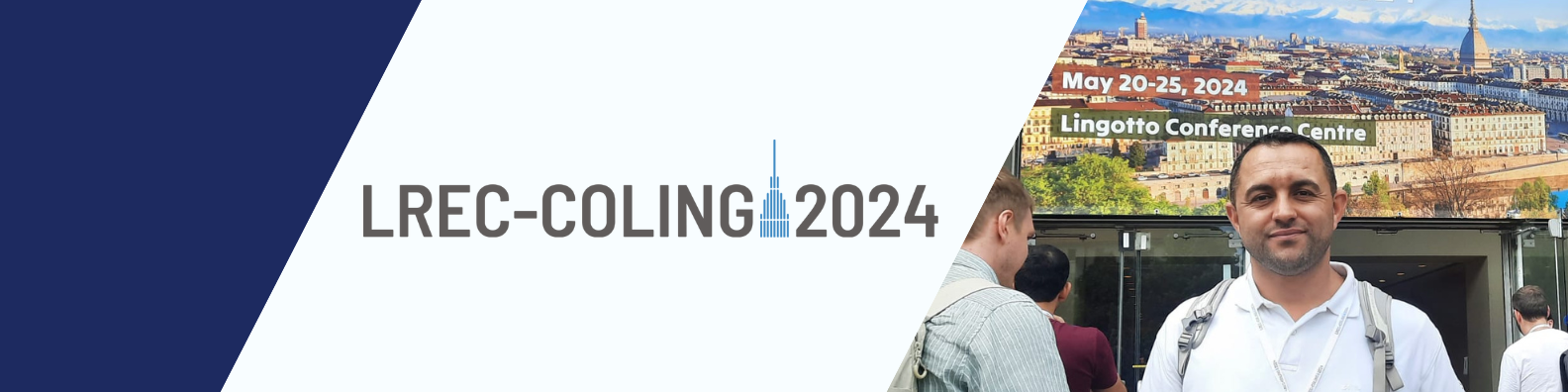
Hadi Khalilia from DataScientia attended the 2024 Joint International Conference on Computational Linguistics, Language Resources, and Evaluation (LREC-COLING 2024), which took place in Torino for three days.
The conference brought together linguistic experts who study language from diverse perspectives. Discussions covered various topics, including computational linguistics, speech, multimodality, and natural language processing. The conference’s main focus was evaluating and developing resources to support work in these areas.
The event was supported by the ELRA Language Resources Association (ELRA) and the International Committee on Computational Linguistics (ICCL), two major international players in computational linguistics.
Hadi Khalilia presented the LiveLanguage initiative to enhance ArabicWordNet (AWN) by closing lexical gaps and expanding synsets. A key reference was the paper “Advancing the Arabic WordNet: Elevating Content Quality,” in which DataScientia researchers introduced the updated AWN V3 version. The LiveLanguage methodology expanded and corrected lemmas, added new glosses, and provided example sentences.
Here below the paper’s abstract:
High-quality WordNets are crucial for achieving high-quality results in NLP (Natural Language Processing) applications that rely on such resources. However, the wordnets of most languages suffer from serious issues of correctness and completeness with respect to the words and word meanings they define, such as incorrect lemmas, missing glosses and example sentences, or an inadequate, Western-centric representation of the morphology and the semantics of the language. Previous efforts have largely focused on increasing lexical coverage while ignoring other qualitative aspects.
In this paper, we focus on the Arabic language and introduce a major revision of the Arabic WordNet that addresses multiple dimensions of lexico-semantic resource quality. As a result, we updated more than 58% of the synsets of the existing Arabic WordNet by adding missing information and correcting errors. In order to address issues of language diversity and untranslatability, we also extended the wordnet structure by new elements: phrasets and lexical gaps.